1. Two Vehicles, Very Different Jobs
If you've been comparing a cargo three wheeler with a passenger auto, you're probably not doing it out of casual curiosity. You're about to spend a significant amount of money, and you want to make sure it earns back. That's a fair expectation and the answer genuinely depends on what you're going to do with it every day.
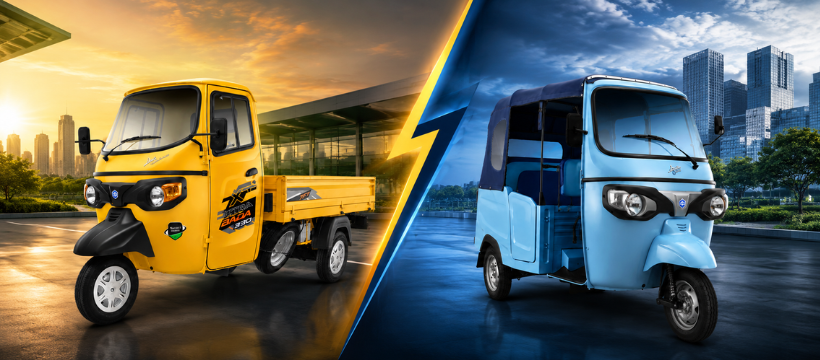
These are not interchangeable vehicles wearing different clothes. They're built around completely different operating logic. One is a moving storage unit. The other is a moving seat. Understanding that difference properly will save you from a costly mismatch.
"These are not interchangeable vehicles wearing different clothes. One is a moving storage unit. The other is a moving seat."
2. What Is a Cargo Three Wheeler?
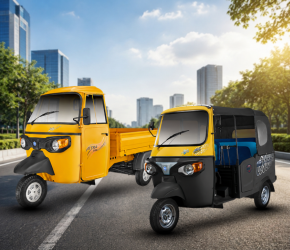
A cargo three wheeler is a commercial vehicle designed to move goods — boxes, produce, raw materials, construction supplies, parcels, or whatever a business needs shifted from one place to another. The load bed replaces the passenger cabin. You get a flatbed, a closed container, or a tipping body depending on the variant.
A cargo auto rickshaw typically operates in last-mile logistics — meaning the final stretch of delivery between a warehouse or hub and the end customer. Urban e-commerce, kirana restocking, vegetable wholesale, and pharmaceutical distribution all lean heavily on these vehicles because they move through congested lanes that larger trucks simply can't access.
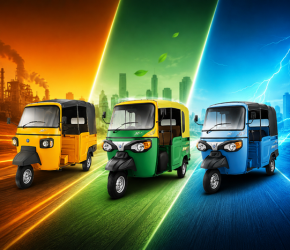
The electric cargo vehicle variant of this segment has grown fast, especially in Tier 1 and Tier 2 cities, where businesses are under pressure to cut fuel costs and urban local bodies are pushing for cleaner freight movement. An electric cargo vehicle has fewer moving parts, lower per-kilometre running costs, and in many states, access to government subsidies that bring the effective purchase price down meaningfully.
3. What Is a Passenger Three Wheeler?
A passenger auto operates differently. Here, the vehicle's value is measured not in kilograms carried but in trips completed. Private passenger vehicles in this segment include school-run autos, rural feeder services connecting villages to highway stops, staff transport for small factories and IT parks, and of course the classic city auto.
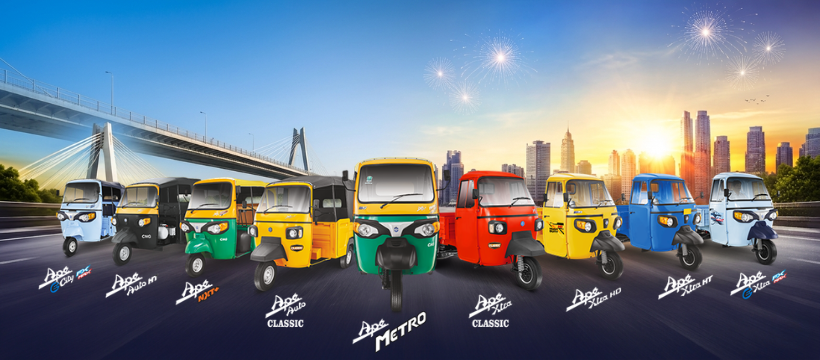
The 3 wheeler Piaggio Apé passenger auto has carved out a distinct space in this category. It's more structured than a typical jugaad-style auto, with better ergonomics and more predictable maintenance. The Apé auto passenger variant is used everywhere from Kolkata's suburban routes to Kerala's narrow coastal lanes. Piaggio passenger auto vehicles tend to attract buyers who want reliability without the complexity of a full bus or van.
Where passenger vehicles often get underestimated is in non-urban settings. A Piaggio Apé passenger running a fixed morning and evening route between a town and a cluster of villages can generate steady, predictable income — a different revenue rhythm from urban cargo but no less valuable.
4. Real-World Use Cases: Who Needs What?
This is where most buying decisions get made — or should be made.
If you run a pharmacy distribution network, a cold-chain vegetable supply chain, or even a laundry pickup and drop business, a cargo auto rickshaw makes sense. You need volume capacity, not seating. The vehicle works longer hours per day and earns based on trips and tonnage.
If you operate a school transport service, a resort shuttle, a temple trust that ferries pilgrims, or a factory that needs shift-change transport for 6 to 8 workers — a passenger auto is the right answer. The Piaggio Apé passenger in particular handles repeated daily cycles well, and the Piaggio passenger auto range has a service network that's wide enough to matter when you're depending on the vehicle commercially.
Cargo auto vehicles also serve informal markets daily — hawkers moving goods from wholesale markets to roadside stalls, construction contractors hauling sand in controlled quantities, water-can delivery businesses. For all of these, the closed cabin of an electric 3 wheeler cargo keeps goods secure and often qualifies for emission-free zone access in cities like Delhi, Bengaluru, and Pune.
5. Cost, Earnings, and ROI: Breaking It Down
This is honest territory. A cargo auto on a good day in last-mile delivery can complete 15 to 25 trips depending on route density. At ₹80 to ₹150 per trip for logistics aggregators, daily earnings are reasonable and consistent.
A passenger auto running on a fixed route earns per head. Urban routes are more competitive but have higher frequency. Rural fixed routes have lower competition and more guaranteed ridership if the route is well-chosen.
EV cargo vehicles and electric passenger autos both cost more upfront than their petrol counterparts. But running costs drop significantly — charging versus fuel is a material difference over a year. Most buyers recover the cost gap within 18 to 24 months purely on fuel savings.
6. The Electric Advantage (and Why the Government Is Backing It)
The government has made it clear, at both the central and state level, that electric three wheelers are a policy priority. Subsidies under FAME and various state-level EV schemes reduce the effective price of both EV cargo vehicles and electric passenger autos. Some states waive road tax and registration fees entirely for EVs. Others offer low-interest financing through public sector banks.
The implication for a buyer is this: if you're choosing between a petrol three wheeler and an electric one, the subsidy structure makes the electric cargo truck and electric passenger options far more competitive than they were three years ago. The gap is closing. In some categories, it's already gone.
7. Where Piaggio Fits Into This Picture?
Piaggio has been in India long enough to have earned a specific reputation: predictable, well-networked, and better finished than most of what competes with it at similar price points. The Piaggio Apé passenger range covers the typical use cases well — school runs, feeder routes, institutional transport.
What makes Piaggio worth considering beyond the badge is after-sales depth. When you're running a commercial vehicle daily, downtime is direct income loss. Piaggio's service network means most buyers don't have to go far to get a problem fixed quickly.
This isn't about loyalty to a brand. It's about operational risk. For a first-time commercial vehicle buyer especially, buying something that's easier to service locally matters.
8. So, Which One Should You Actually Buy?
If your business moves goods, buy a cargo three wheeler. If your business moves people, buy a passenger auto. Don't try to make one do the job of the other — it won't work, and it won't earn.
If you're at the edge of deciding on fuel type, lean toward electric if your daily route is under 100 km and you have a reliable charging point. The subsidies are real, the running cost difference is real, and the direction policy is moving is clear.
And if you're leaning toward the passenger segment and want something dependable for commercial use, the Piaggio Apé passenger lineup deserves a proper look before you sign anything.
The best vehicle is the one that fits your actual daily use. Start there, and the rest of the decision usually follows.
9. Frequently Asked Questions
1. Which 3 wheeler auto is best?
The Bajaj RE is widely considered the best due to its reliability, fuel efficiency, low maintenance, and strong service network. It's a top choice for both drivers and fleet owners across India.
2. What is a cargo three-wheeler?
A cargo three-wheeler is a small commercial vehicle designed to transport goods. Models like the Mahindra Treo Zor are used for last-mile delivery due to their compact size, affordability, and efficiency.
3. Are three-wheelers good for long distances?
Three-wheelers are best suited for short to medium distances within cities. While they can handle longer trips, comfort, speed, and durability may be limited compared to larger vehicles.
4. Which is the number 1 three-wheeler in India?
The Bajaj RE is often ranked number one in India due to its widespread use, durability, strong resale value, and extensive service network.